



 Orchestra
  DIGITAL WORLD
 BRICS+ Media Centre
  MODERN RUSSIAN












 17.06.2617:00
  15.06.2612:00

China creates micro-robot that can change shape
The development by Tsinghua researchers could be used in hard-to-reach environments instead of humans
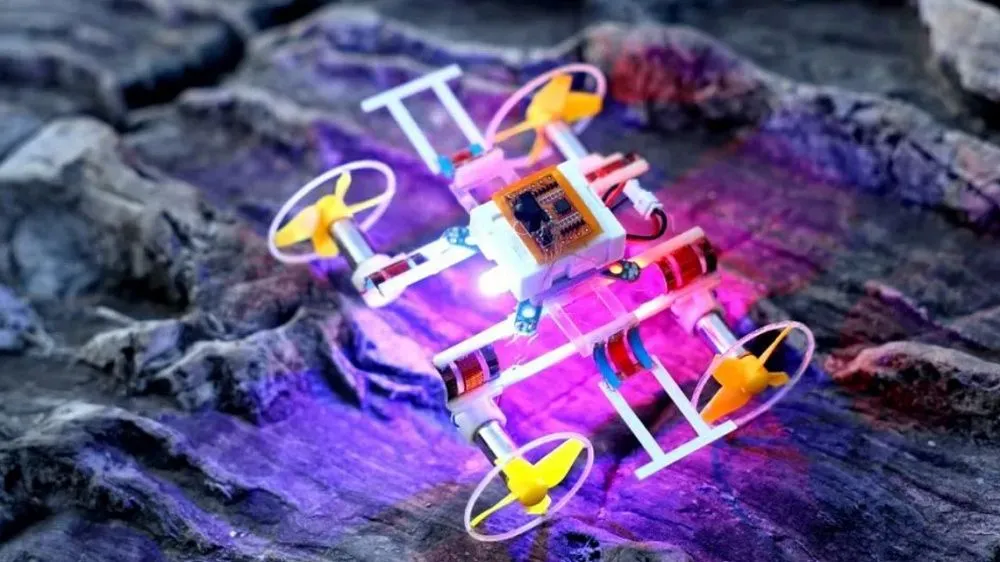
A team of Chinese scientists from Tsinghua University has unveiled the world's smallest and lightest autonomous land-air micro-robot capable of changing shape depending on the task. The device is 9 centimetres long and weighs 25 grams and can move both on the ground and in the air, reaching speeds of up to 1.6 metres per second. This is reported by the Global Times, a partner of TV BRICS.
The design is based on a specially developed thin-film actuator that allows the robot to continuously change shape and lock into a given configuration, extending its functionality in different environments. The team emphasises that such capabilities were previously unavailable for small-scale actuators, especially self-powered ones.
The actuator is a device with controllable shape-morphing capability and serves as the "heart" of a microrobot.
One of the challenges of the project was to overcome the limitations of miniaturisation and autonomy. According to Zhang Yihui, a professor from the School of Aerospace Engineering and the State Key Laboratory of Flexible Electronics Technology of Tsinghua University, the new design allows the robots to run, fly, jump, climb, and fix shape – greatly expanding the range of applications from equipment diagnostics to archaeological research.
In addition to the main micro-robot, the team also demonstrated a miniature transforming actuator, 4.5 cm high and weighing less than a gram, consisting of more than 10 elements.
According to the developers, the technology could be used in other fields, including bioelectronic devices, such as implantable medical systems or haptic interfaces for virtual and augmented reality. The actuator could also be adapted to create vascular stents that open in blood vessels to improve blood flow.
Photo: research team / Global TimesMORE ON THE TOPIC
 25.06.2618:00
  24.06.2615:00
 23.06.2615:00


 23 minutes 27 sec.