

















Since the late 1990s, more than 2,000 dinosaur footprints have been found in the same area
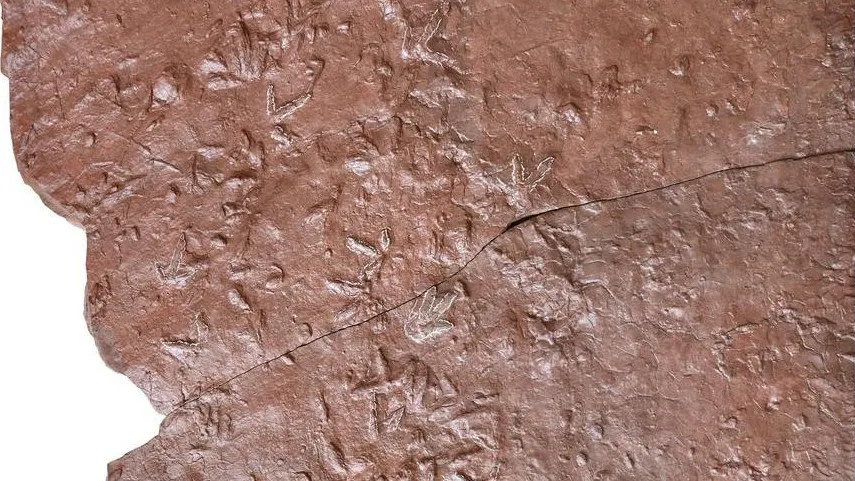
Fossilised footprints of prehistoric creatures hundreds of millions of years old, including bird, turtle, and dinosaur tracks, have been discovered in northwest China. This is reported by Xinhua News Agency, a partner of TV BRICS.
The fossils were found in Yongjing county, Gansu Province, in a red sandstone of the Lower Cretaceous period.
The research team found six sites with footprints. Five of them belong to ancient birds, one to turtles, and one to theropods (a group of dinosaurs).
This is the first discovery of turtle footprints in China, indicating their coexistence with birds during that period.
Tortoise tracks of different sizes were found, and some of them overlapped with bird tracks. This suggests that turtle tracks appeared earlier.
The bird tracks are 3 to 4 centimetres long, which is similar to the tracks of Koreanaornis lii, a common bird species from the Cretaceous period in China.
The only section of the footprints that did not have bird tracks was a 16.6 cm long symmetrical three-toed print, which probably belongs to a small ankylopollexian.
The study shows that during the age of dinosaurs, animals adapted to different aquatic habitats depending on their size. The discovery will help scientists study ancient aquatic ecosystems.
Since the late 1990s, more than 2,000 dinosaur footprints have been found in the Yongjing area. The latest findings have attracted a lot of media attention.
Photo: Xinhua News Agency
-
![]()
 Society25.08.26BRICS countries seek stronger support for children from early years to adulthood
 -
![]()
 Society24.08.26Head of International Relations Department of TVRI: Indonesia takes centre stage in multipolar media
 -
![]() Society23.08.26BRICS News Digest for the previous week
Society23.08.26BRICS News Digest for the previous week -
![]()
 Society22.08.26Oman identifies seven mushroom species new to science
 -
![]()


 Society21.08.26Projects in field of higher education in Iran to be presented to international public through TV BRICS
 -
![]()


 Society20.08.26Citizens of Kyrgyzstan and Vietnam to use 240-hour visa-free transit through China

























-
![Joao Paulo Capobianco]()
 Joao Paulo CapobiancoBrazilian Minister of the Environment and Climate Change"The BRICS countries have a very high level of responsibility because they share an important part of the world's biodiversity, landscapes, populations, food production and water resources. So, we have an opportunity to lead by example. We have our development bank, which can demonstrate and develop new ways of financing programmes. We can reduce the risks for private capital to invest in restoration and efforts to combat desertification"
 -
![Dilma Rousseff]() Dilma RousseffPresident of the New Development Bank"India’s BRICS Presidency this year gives special significance to our discussion. NDB stands ready to be a trusted partner in turning commitments on sustainability, clean energy, smart and resilient infrastructure into concrete results on the ground. […] For NDB, mobilising private capital is a strategic imperative. Created by the BRICS founding members, NDB is a bank of the Global South, for the Global South, mandated to mobilise resources for infrastructure and sustainable development"
Dilma RousseffPresident of the New Development Bank"India’s BRICS Presidency this year gives special significance to our discussion. NDB stands ready to be a trusted partner in turning commitments on sustainability, clean energy, smart and resilient infrastructure into concrete results on the ground. […] For NDB, mobilising private capital is a strategic imperative. Created by the BRICS founding members, NDB is a bank of the Global South, for the Global South, mandated to mobilise resources for infrastructure and sustainable development" -
![Sihasak Phuangketkeow]() Sihasak PhuangketkeowDeputy Prime Minister and Minister of Foreign Affairs of Thailand"BRICS can play a very important role in maintaining the free flow of trade and investment. The group can also be a vehicle for all of us to engage and to look at economic opportunities"
Sihasak PhuangketkeowDeputy Prime Minister and Minister of Foreign Affairs of Thailand"BRICS can play a very important role in maintaining the free flow of trade and investment. The group can also be a vehicle for all of us to engage and to look at economic opportunities"