















GITIS brings first theatre arts school in South Africa
GITIS lecturers conducted masterclasses for professional actors and aspiring performers in Johannesburg and Pretoria
-
![]()
Photo source: GITIS
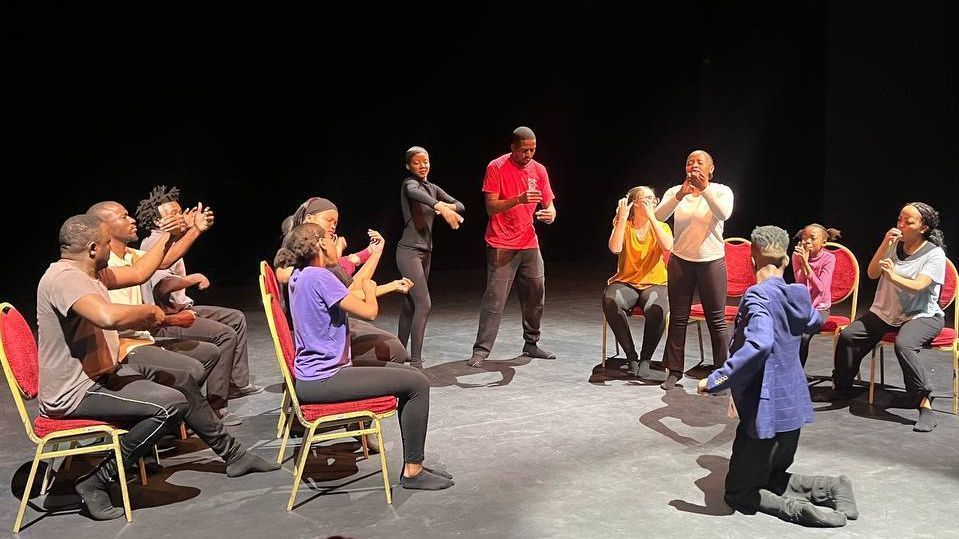
The Russian Institute of Theatre Arts (GITIS), a partner of TV BRICS, has held its first educational programme in South Africa. Masterclasses for professional actors and aspiring performers took place in Johannesburg and Pretoria, the institute's press service reported.
Participants were introduced to Russian methods of actor training, while GITIS lecturers presented a range of approaches to working with performers.
The Russian delegation included theatre director and Honoured Artist of Russia Irina Galibina, stage movement lecturer Peter Novikov, and Arina Smirnova, a student from Mikhail Reznikovich's workshop. The classes were also led by GITIS graduate of the Faculty of Choreography, Slou Akimguereeva, who represents the institute in Africa.
The masterclasses were attended by professional actors and aspiring performers aged between 15 and 17.
"The participants said that, even for those who are already professional actors, this was an entirely new experience unlike anything they had encountered before. Some of them already work with children in theatre studios and schools, and they told us that they had already started using our exercises in their own practice," Irina Galibina noted.
The first stage of the programme took place on the stage of the Johannesburg Theatre. The classes were based on Anton Chekhov's play "Uncle Vanya". The masterclasses concluded with a sketch performance inspired by the play, which the participants presented to the audience. The performance was attended by representatives of the Embassy of Russia in South Africa, the theatre's management and other invited guests.
The second stage was held at the South African State Theatre in Pretoria. There, the lecturers moved away from working with a specific dramatic text and instead structured the classes according to the same model they use with their students in Moscow. Participants showed particular interest in exercises designed to develop a sense of rhythm. The programme included coordination, agility and movement exercises, elements of stage acrobatics and the fundamentals of Meyerhold's biomechanics. The final presentation took the form of an open lesson, during which the exercises and practical tasks followed one another.
The programmes in Johannesburg and Pretoria differed in both format and content, allowing participants to become acquainted with various approaches employed in Russian theatre education.
The organisers hope that the project will become the first step towards developing cooperation between the theatres of Russia and South Africa.
The project was implemented under the Priority 2030 Strategic Academic Leadership Programme. The visit by the GITIS lecturers was organised with the support of the Embassy of the Russian Federation in South Africa.
-
![]()

 Culture11.09.26Republic of India to promote creative industries abroad through TV BRICS
 -
![]()
 Culture09.09.26"Russian theatre changes world's perception of performing arts" – InteRussia participants on their fellowship at GITIS
 -
![]()
 Culture03.09.26FAM 2026 International Film Festival returns to Santa Catarina, celebrating 30 years
 -
![]()
 Culture26.08.26Films from BRICS countries to be screened at “Salt of the Earth” Film Festival in Russia
 -
![]() Culture25.08.26Fellowship programme for actors from BRICS+ countries starts in Russia
Culture25.08.26Fellowship programme for actors from BRICS+ countries starts in Russia -
![]()
 Culture14.08.26Summer "Russian Seasons" comes to close in Thailand




-
![Ashok Mondal]()
 Ashok MondalNID Director"Signing this Memorandum of Understanding between the National Institute of Design (NID) and TV BRICS marks a pivotal milestone in advancing design diplomacy across the BRICS media space. This moment is especially significant as India hosts the 18th BRICS Summit, following India’s assumption of the BRICS chairship under the visionary leadership of Prime Minister Shri Narendra Modi. The partnership directly embodies his call to elevate Indian design standards through 'Design in India, Design for the World'. Through the global reach and broadcast capabilities of TV BRICS, we are excited to showcase the extraordinary visual storytelling, films, and design research of NID’s Film and Video Communication students to an international audience, while also welcoming and screening film works from BRICS network countries at NID Ahmedabad. This reciprocal exchange strengthens our shared commitment to educational, cultural, and artistic collaboration, fostering sustainable connections among global creative communities. NID Ahmedabad looks forward to leveraging this partnership to deepen cross-cultural dialogue, build international expert networks, and unlock transformative opportunities for filmmakers, researchers, and faculty across member nations"
 -
![Vladimir Putin]() Vladimir PutinPresident of Russia"We are developing mutual trade, which is growing; it increased by over 12 per cent last year. We have a joint commission working in this sphere. Our focus is on agriculture, shipbuilding, information technology and energy, including nuclear power. We have signed a free trade agreement between the Eurasian Economic Union and Indonesia. Jakarta is our reliable and old friend within ASEAN. We are working together at all international platforms, including the UN"
Vladimir PutinPresident of Russia"We are developing mutual trade, which is growing; it increased by over 12 per cent last year. We have a joint commission working in this sphere. Our focus is on agriculture, shipbuilding, information technology and energy, including nuclear power. We have signed a free trade agreement between the Eurasian Economic Union and Indonesia. Jakarta is our reliable and old friend within ASEAN. We are working together at all international platforms, including the UN" -
![Vladimir Putin]() Vladimir PutinPresident of Russia"More and more Iranian students are choosing Russian education. We are very pleased about this. A great many future doctors are studying in Russia. In the 2025–2026 academic year, the number of Iranian students in Russia approached 10,000, with 802 of them studying at the expense of the Russian state budget"
Vladimir PutinPresident of Russia"More and more Iranian students are choosing Russian education. We are very pleased about this. A great many future doctors are studying in Russia. In the 2025–2026 academic year, the number of Iranian students in Russia approached 10,000, with 802 of them studying at the expense of the Russian state budget" -
![Xi Jinping]() Xi JinpingPresident of the People’s Republic of China"The foundation of our bilateral relations will only grow stronger, and we will confidently move forward to a better future. […] The striving of nations on our planet for peace, development, cooperation and mutual benefit remains unchanged. The vital mission of the Shanghai Cooperation Organisation is to maintain stability and promote the development of our region"
Xi JinpingPresident of the People’s Republic of China"The foundation of our bilateral relations will only grow stronger, and we will confidently move forward to a better future. […] The striving of nations on our planet for peace, development, cooperation and mutual benefit remains unchanged. The vital mission of the Shanghai Cooperation Organisation is to maintain stability and promote the development of our region" -
![Alisher Salomov]() Alisher SalomovAdviser to the Chairman of the National Committee for Ecology and Climate Change of the Republic of Uzbekistan"First and foremost, I would like to highlight the importance of this Central Asia–Russia initiative, because environmental problems know no borders, and only a shared understanding of these problems and the search for joint solutions can deliver positive results"
Alisher SalomovAdviser to the Chairman of the National Committee for Ecology and Climate Change of the Republic of Uzbekistan"First and foremost, I would like to highlight the importance of this Central Asia–Russia initiative, because environmental problems know no borders, and only a shared understanding of these problems and the search for joint solutions can deliver positive results"