



 Orchestra
  DIGITAL WORLD
 BRICS+ Media Centre
  MODERN RUSSIAN













Sergey Tolchenov, Russia’s Ambassador to Indonesia: Free trade agreement with EAEU to double Russia–Indonesia trade within 3–5 years
In an exclusive interview with TV BRICS, the diplomat spoke about the results of Indonesia’s first year of work in the group and the prospects for Russian–Indonesian cooperation
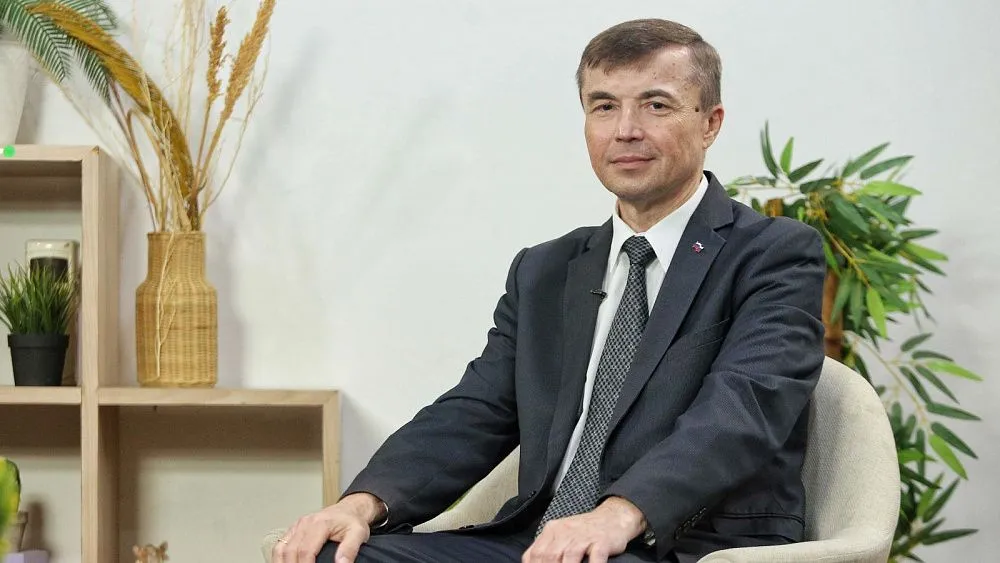
Sergey Tolchenov is Ambassador Extraordinary and Plenipotentiary of the Russian Federation to the Republic of Indonesia. He was born in 1965 and graduated in 1988 from the Moscow State Institute of International Relations of the Ministry of Foreign Affairs of Russia. He speaks English, French and Vietnamese. He has been in diplomatic service since 1988.
From 2008 to 2013, he served as Minister-Counsellor of the Russian Embassy in Indonesia; from 2013 to 2024, he was Deputy Director of the Third Asia Department of the Russian Ministry of Foreign Affairs. He holds the diplomatic rank of Envoy Extraordinary and Plenipotentiary, 1st Class.
He previously worked at the embassies of the USSR and Russia in Cambodia (1988–1992), Vietnam (1994–1998, 2002–2005), and at the Consulate General of Russia in Ho Chi Minh City (2000–2002).
2025 marked Indonesia’s first year of full-format participation in BRICS activities. In your view, how successfully has the country adapted to working within the group? How has accession to BRICS affected relations between Moscow and Jakarta?
Indeed, 2025 became the first year of the Republic of Indonesia’s full membership in BRICS. In my view, it can be confidently stated that Jakarta is demonstrating an engaged and constructive approach to its work within BRICS, has joined cooperation across most areas, and is making a solid contribution in the work of the group.
Representatives of the Republic of Indonesia took part in most meetings organised under the Brazilian presidency, while President Prabowo Subianto participated in two summits – in July in Rio de Janeiro and in September, which was held online.
The results of the past year show that Indonesia shares BRICS’ general approaches on most issues under consideration, pays particular attention to reform of the World Trade Organisation (WTO) and strengthening the multilateral trading system, sustainable development, addressing the consequences of climate change, the energy transition, and criteria for the use of artificial intelligence. Indonesian youth are noticeably present at BRICS events. Indonesian legislators have joined the activities of the BRICS Parliamentary Forum.
We expect Jakarta’s active participation in initiatives on cooperation in geology and subsoil use, hydrometeorology, and in working groups on counter-terrorism and information and communications technology (ICT) security […]. We also count on Indonesia’s involvement in the establishment of a cross-border payment initiative, settlement, clearing and depositary infrastructure, a new investment platform and the BRICS Grain Exchange. Indonesia has, in principle, expressed its intention to join the New Development Bank and is currently working through this issue within its domestic procedures.
Our bilateral relations have only strengthened following Indonesia’s accession to BRICS. An additional track for contacts has emerged, including at the level of various ministries and agencies. All of this complements and diversifies the substance of our multifaceted ties.
Trade between Russia and Indonesia in the first 10 months of 2025 increased by 18 per cent to US$3.6 billion. You have noted that by the end of the year this figure could exceed US$5 billion, and the expected result is significantly higher than in 2024. What factors are currently contributing to the sustained growth in trade volumes between the two countries?
Our countries have a solid foundation for cooperation across a wide range of sectors, including energy, agriculture, metallurgy, the chemical industry, and the information technology sector. Progress in these and other areas is facilitated by intensive dialogue at the level of heads of state: in 2025, Presidents Vladimir Putin and Prabowo Subianto met three times, and each time discussions covered a broad range of economic issues.
In addition, in April 2025, after a seven-year break largely related to pandemic restrictions, a meeting of the Russian–Indonesian Intergovernmental Commission and a representative bilateral business forum were held in Jakarta. Close interaction between governments and business communities undoubtedly has a positive effect on advancing our cooperation. The Declaration on Strategic Partnership between Russia and Indonesia, approved by the two presidents in June 2025, has also played a role.
One of the key drivers for increasing trade in the future is the free trade agreement (FTA) between Indonesia and the EAEU, signed at the end of 2025. In your opinion, to what extent could it boost trade volumes between the countries after ratification by all parties? Which categories of goods will benefit from preferences?
The signing on 21 December 2025 of the Free Trade Agreement between the EAEU, its member states and the Republic of Indonesia was undoubtedly one of the key events of last year’s economic agenda. The document is currently awaiting ratification by all signatories. The Government of the Russian Federation has already submitted it to the Federal Assembly. We hope for the swift completion of this process and the agreement’s early entry into force.
This is not merely about tariff reductions but about creating more predictable and convenient conditions for mutual trade. According to the Eurasian Economic Commission, within a 3–5 year horizon after the agreement enters into force, bilateral trade could double. The Indonesian side is opening preferential access for around 90 per cent of the product range, while the average applied tariff on EAEU goods is expected to fall from approximately 10.2 per cent to 2 per cent.
Under the agreement, trade preferences will cover a wide range of goods. For EAEU exporters, including Russian producers, this primarily concerns agricultural products, including grain crops, flour, bakery products, fish, meat and dairy products, and mineral water. Significant opportunities also arise for industrial goods: metallurgical products, petroleum products, coal, fertilisers, polymers, timber and other forestry products, construction machinery and various types of equipment.
It should be emphasised that the significance of the agreement goes beyond tariff concessions. It creates additional opportunities to remove technical barriers, simplify customs procedures, ensure more transparent application of sanitary and phytosanitary requirements, and develop industrial cooperation. In other words, it should stimulate not only an increase in trade volumes but also a qualitative improvement in economic ties – from simple exchange of goods to deeper partnership in industry, agriculture, logistics and investment.
In your opinion, how will the signing of the free trade agreement, as well as the opening of a representative office of the Russian Export Centre in the republic, affect the number of Russian exporters working with Indonesia?
Taking into account, as already noted, the wide range of goods for which customs duties will be reduced or eliminated under the agreement, I believe that the free trade area involving the five EAEU countries will make Indonesia more attractive for Russian producers and help establish logistics routes for the supply of goods.
However, this is only a legal framework, the effective use of which requires practical efforts by the business community, the establishment of direct business links and the exchange of information about available opportunities. To facilitate the search for partners for Russian enterprises, a number of overseas institutions are already operating in Jakarta, including the trade mission. In this regard, the opening of a representative office of the Russian Export Centre (REC), which already has a substantial portfolio of initiatives, creates an additional window of opportunity for domestic exporters.
According to estimates by the federal centre Agroexport, the potential for grain shipments to Indonesia by 2030 exceeds US$420 million. In your opinion, how could the BRICS Grain Exchange affect agricultural export volumes in the future? Is Jakarta showing interest in this project?
In my view, Indonesia, as a full-fledged participant in BRICS and in line with its priorities of ensuring food security and diversifying foreign economic ties, is showing steady interest in the emerging BRICS agro-industrial infrastructure. Jakarta shares the view that the creation of a grain exchange within the grouping will help protect national markets from external interference, ensure fair pricing for grain and enable long-term contracts, which is particularly important for Indonesia as one of the largest grain importers.
The use of national currencies in mutual settlements has been discussed within the framework of the Russia–Indonesia working group on banking and finance. At what stage are the negotiations today? What issues are currently on the agenda?
The establishment of direct settlements, including in national currencies, is one of the key objectives of Russian–Indonesian cooperation. The creation of stable payment channels independent of third-country currencies and banks is essential for further increasing bilateral trade, implementing major joint investment projects and creating favourable conditions for tourists and ordinary citizens travelling between Russia and Indonesia.
Equally important is maintaining a balance between the security of the payment system and its convenience for businesses. The settlement mechanism must be convenient for all stakeholders, who are numerous and diverse in their needs, while reflecting modern standards of data protection against malicious interference.
The Russian Ministry of Economic Development identifies the creative sector as an important area for expanding cooperation with Indonesia. The countries are negotiating the creation of a joint working group in this field. In your view, which areas of the knowledge economy and creative industries are currently most in demand in the republic? How will partnership in this area affect exports and job creation in both countries?
Recently, Indonesian partners have been regularly raising the topic of cooperation in the creative economy, for which a dedicated government body has been established. Promising areas include cinematography, design and fashion, and gastronomy. For example, we have repeatedly heard proposals to develop joint film production. Given the closeness of our countries in terms of spiritual and moral values, such projects could be particularly interesting, especially if devoted to the history of our peoples and their cooperation.
At the same time, the Indonesian side is ready to provide locations for filming feature films by Russian directors. Indonesian designers regularly participate in fashion shows in Russia, presenting collections with distinctive national elements. There is also interest in introducing Russian audiences to Indonesian batik, a traditional dyed textile widely used both in formal attire and everyday clothing.
Cuisine is another important area. In October 2025, a delegation from the Association of Restaurateurs and Hoteliers of Kazan and the Republic of Tatarstan took part in the International Halal Chef Competition held in Jakarta.
Literature and translation are also significant. Bookshops in Indonesia feature works by Tolstoy, Dostoevsky, Chekhov and other Russian classics. There is a task to promote contemporary Russian authors. Indonesian literature is less well known in Russia, although last year Indonesian writer and head of the Indonesian Writers’ Union, Denny JA, received a special prize “For Innovation in Literature” at the BRICS International Literary Award. In addition, the book “Indonesia: A Literary Lexicon”, covering more than 900 writers, was published in Russia with the support of the Russia–Indonesia Friendship Society.
Russian culture has always resonated strongly in Indonesia, as noted by Russian Minister of Culture Olga Lyubimova. At the end of 2025, Days of Russian Spiritual Culture were held in Jakarta, and the national library is developing an electronic service providing access to books in Russian. In your opinion, what explains Indonesian interest in Russian culture? How will cultural exchanges develop in the foreseeable future?
In my view, Indonesian interest in Russian culture has deep and natural roots. Russia’s great literary heritage, classical music, philosophical tradition, ballet, theatre, and cinema carry a powerful humanitarian message and convey universal values of kindness and mutual respect. At the same time, Indonesians perceive Russia not through stereotypes but through direct cultural experience, including events organised with the support of Russian overseas institutions in Jakarta. They clearly see the alignment of our fundamental values – respect for tradition, family, spiritual heritage, and cultural and religious diversity. Both countries are multi-ethnic and multi-confessional civilisational states, where culture has developed as a space for dialogue among different peoples, languages and traditions. This multi-layered nature makes Russian culture understandable and appealing to Indonesians.
Recently, a number of cultural events have been held in Jakarta, the largest of which was a gala concert in April 2025 featuring Russian and Indonesian artists, dedicated to the 13th meeting of the Russian-Indonesian Joint Commission on Trade, Economic and Technological Cooperation. Performers included the State Academic Dance Ensemble of Dagestan "Lezginka" and the State Academic Russian Folk Choir named after M. E. Pyatnitsky. Last year also saw the international cultural and educational project “A Word about the Russian Heart"; Days of Russian Spiritual Culture in Indonesia; as well as film screenings and joint cultural events organised by the embassy together with Indonesian public and student organisations. All of these have received a lively and positive response from audiences.
The growing interest of Russians in Indonesia is reflected in increasing tourist flows: in 2025, a record was set, with more than 219,000 travellers visiting the republic. Currently, only one regular flight operates between Moscow and Denpasar. Are there any plans to expand air connections, increase the number of regular flights or open new routes, as well as simplify the visa regime?
Issues related to the expansion of air services are handled by the Russian Ministry of Transport. At present, only one Russian airline operates flights to Indonesia. Local authorities periodically express interest in seeing more Russian carriers, but no concrete initiatives have been announced so far.
As for visa facilitation, a draft bilateral intergovernmental agreement is currently under consideration, and negotiations are ongoing to agree on its provisions. At the same time, it should be noted that Indonesia is included in the list of countries whose citizens can obtain a unified electronic visa to enter Russia, as well as apply for a multiple-entry tourist visa valid for up to six months based on hotel booking confirmation or other accommodation arrangements.
During a meeting in the Kremlin in December 2025, President of Indonesia Prabowo Subianto invited Russian President Vladimir Putin to visit Jakarta in 2026 or 2027. How is work on this matter progressing?
During the meeting held on 10 December 2025 in Moscow, President Vladimir Putin accepted the invitation of his Indonesian counterpart Prabowo Subianto to pay a return visit in 2026 or 2027. Such a visit will require thorough preparation, primarily in terms of implementing previously reached agreements. Specific dates will be agreed through diplomatic channels, taking into account the schedules of both heads of state.
MORE ON THE TOPIC


 24 minutes 26 sec.