















Russian scientists develop ultra-strong ceramics for aerospace industry
Six compositions of the new material can withstand temperatures of up to 2,100 degrees and radiation exposure
-
![]()
Photo source: gorodenkoff / iStock
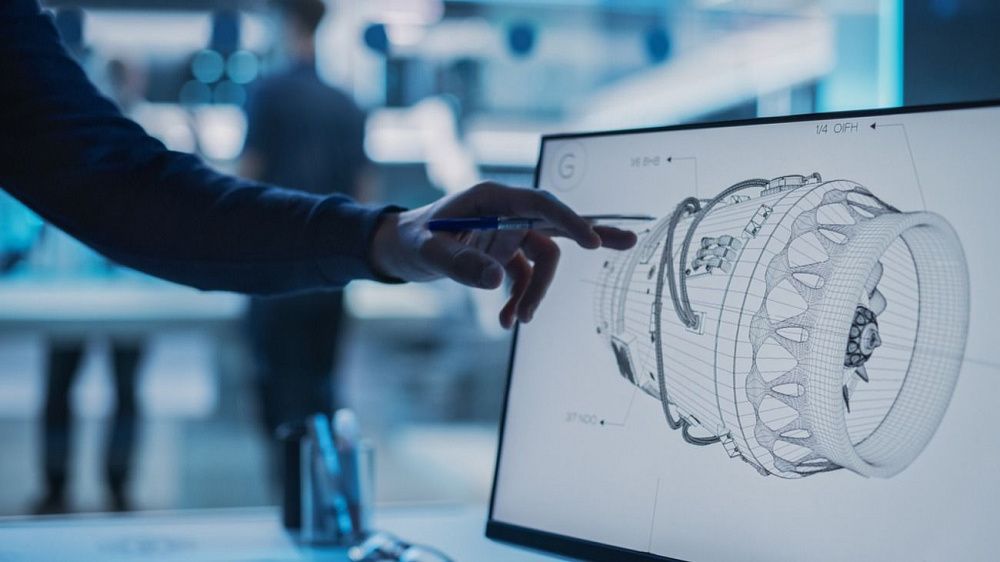
Six compositions of ultra-strong ceramics capable of withstanding temperature fluctuations and radiation exposure have been developed. The material can be used in the aerospace industry. The development was created by scientists at Ural Federal University (UrFU), according to the website of the Russian Ministry of Science and Higher Education.
The new ceramics belong to the class of high-entropy materials – complex oxides made up of five or more components. These are not composites but a single solid solution of five or more constituents that form a common crystal lattice.
The new ceramics can withstand temperatures of up to 2,100 degrees. In terms of their properties, they outperform stabilised zirconium dioxide, which is currently used in industry.
“All the samples demonstrate high radiation resistance, while some alloys did not ‘feel’ the irradiation at all. By comparison, stabilised zirconium oxide undergoes structural changes at the same radiation doses,” explained one of the study's authors, Roman Bastrikov, an engineer at the Department of Rare Metals and Nanomaterials at UrFU.
The ceramics conduct heat less effectively than zirconium dioxide and are therefore less prone to degradation. In terms of thermal expansion, they are highly compatible with metal and deform less together with the metal substrate. This makes the material more reliable and durable.
The new ceramics can be used for thermal protection coatings, electrolytes for fuel cells, substrates and insulators for onboard electronics, as well as components for hypersonic vehicles. The scientists plan to work with industrial partners to further improve the compositions.
-
![]()
 Technology28.09.26Egypt launches its first domestically developed industrial robot
 -
![]()
 Technology27.09.26Oman explores air-to-water technology for sustainable farming
 -
![]()
 Technology26.09.26Nigeria performs first tele-robotic surgery
 -
![]()
 Technology26.09.26China completes major superconducting magnet for fusion project
 -
![]()
 Technology25.09.26Russia to begin parachute tests of advanced crewed spacecraft in 2026
 -
![]() Technology24.09.26China completes world’s tallest wind measurement tower
Technology24.09.26China completes world’s tallest wind measurement tower















-
![Evgeny Solntsev]()
 Evgeny SolntsevGovernor of Orenburg Region (Russia)"We see growth year after year. Last year, the figure increased by 11.6 per cent. The total share of our products on the sales market is around 24.7 per cent. BRICS countries account for a quarter of all our products. Good-neighbourly relations with Kazakhstan are very important for us. Then come China and India. We primarily focus on these countries because they are our closest neighbours"
 -
![Elias Monage]() Elias MonageChairman of the South African side of the Russia-South Africa Business Council"If we are then to do a huge project, for example, on rail infrastructure, we can then bring the rest of the continent to participate in the rail development and infrastructure for the continent together with the partners within the BRICS countries. Whether we then bring, for example, Russia rail, we then bring India, we then bring China"
Elias MonageChairman of the South African side of the Russia-South Africa Business Council"If we are then to do a huge project, for example, on rail infrastructure, we can then bring the rest of the continent to participate in the rail development and infrastructure for the continent together with the partners within the BRICS countries. Whether we then bring, for example, Russia rail, we then bring India, we then bring China" -
![Maksim Reshetnikov]() Maksim ReshetnikovRussian Minister of Economic Development"Plan 2030 has created a strong foundation for the qualitative expansion of trade and economic ties. There are all grounds to believe that by the end of the decade, Russia–China trade will reach US$300 billion"
Maksim ReshetnikovRussian Minister of Economic Development"Plan 2030 has created a strong foundation for the qualitative expansion of trade and economic ties. There are all grounds to believe that by the end of the decade, Russia–China trade will reach US$300 billion"


