















Chinese customs deploy AI-powered biosecurity systems to strengthen border protection
New “space–air–ground” monitoring networks enhance biological risk prevention and accelerate customs clearance across China
-
![]()
Photo source: Xinhua News Agency
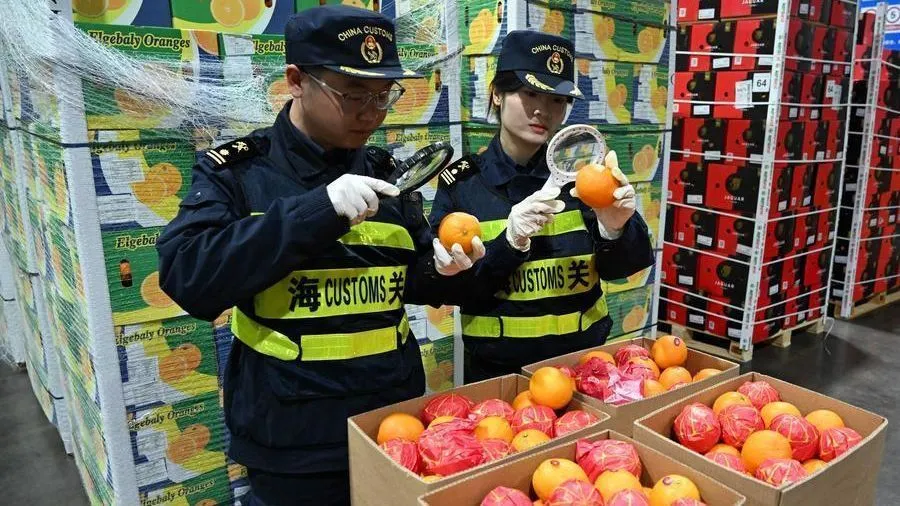
China is upgrading its border biosecurity framework through the integration of artificial intelligence and big data technologies. Since 1 May 2026, an official list of high-risk invasive alien species has been in force at the country’s borders, with strict control measures applied to prevent biological threats. Earlier this year, Chinese customs authorities launched a three-year nationwide campaign aimed at strengthening pest prevention and biosecurity management. The initiative was jointly developed by the General Administration of Customs (GACC) of China and five other government departments. This was reported by Xinhua News Agency, a partner of TV BRICS.
An intelligent identification model for invasive pests has been introduced at customs checkpoints nationwide. According to Liu Jian, Deputy Director of the GACC’s Department of Animal and Plant Quarantine, the system can recognise more than 1,000 species of insects and invasive weeds with an accuracy rate exceeding 90 per cent. Through the integration of interdepartmental databases, customs authorities can now conduct instant verification of 12 categories of agricultural products. More than 120,000 electronic declarations have already been processed. Automated sampling systems and intelligent detection technologies help maintain high biosecurity standards while ensuring efficient cross-border trade flows.
In east China’s Zhejiang Province, customs officers have begun using AI-enabled smart glasses. The devices instantly identify product characteristics and translate foreign-language labels, reducing cargo processing times by approximately 30 per cent. At Tianjin Port, specialised digital inspection systems carry out comprehensive checks of mineral raw materials within minutes.
Customs authorities in Zhangjiagang are also applying artificial intelligence to monitor timber imports. The systems can identify 145 wood species, more than 150 types of weed seeds and 80 insect species. Meanwhile, Jinling Customs in Nanjing uses AI-assisted technologies to detect live exotic parasites in international postal shipments.
China is also expanding cooperation with neighbouring countries. A cross-border intelligent monitoring system based on artificial intelligence and big data is being developed to strengthen regional biosecurity coordination. Participating countries are exchanging biological species databases, conducting joint field monitoring and carrying out collaborative risk assessments.
A representative of a local enterprise in Manzhouli involved in importing grain, oilseed crops and animal feed from Russia noted that the comprehensive phytosanitary inspections conducted by Manzhouli Customs help businesses maintain high standards of sanitary compliance throughout procurement, transportation and storage processes. Over the long term, these measures contribute to smoother customs procedures and greater operational reliability.
Officials noted that the introduction of intelligent technologies has significantly improved customs efficiency. Even during periods of high cargo volumes, the time between the submission of a preliminary declaration and on-site inspection is now approximately two hours.
Chinese authorities believe that the continued development of intelligent border supervision systems will further support the sustainable growth of international trade and economic cooperation.
-
![]()
 Technology12.09.26Brazil launches AI solutions bank for public administration
 -
![]()

 Technology12.09.26India to showcase its scientific and technological potential through TV BRICS
 -
![]() Technology12.09.26Russia launches 5G network
Technology12.09.26Russia launches 5G network -
![]()
 Technology11.09.26Iranian researchers improve water quality modelling accuracy by up to 43%
 -
![]() Technology10.09.26Russian scientists develop technology to build houses at lower cost
Technology10.09.26Russian scientists develop technology to build houses at lower cost -
![]()
 Technology09.09.26INOTEX 2026 connects 10 countries through technology, investment and startup cooperation








-
![Ashok Mondal]()
 Ashok MondalNID Director"Signing this Memorandum of Understanding between the National Institute of Design (NID) and TV BRICS marks a pivotal milestone in advancing design diplomacy across the BRICS media space. This moment is especially significant as India hosts the 18th BRICS Summit, following India’s assumption of the BRICS chairship under the visionary leadership of Prime Minister Shri Narendra Modi. The partnership directly embodies his call to elevate Indian design standards through 'Design in India, Design for the World'. Through the global reach and broadcast capabilities of TV BRICS, we are excited to showcase the extraordinary visual storytelling, films, and design research of NID’s Film and Video Communication students to an international audience, while also welcoming and screening film works from BRICS network countries at NID Ahmedabad. This reciprocal exchange strengthens our shared commitment to educational, cultural, and artistic collaboration, fostering sustainable connections among global creative communities. NID Ahmedabad looks forward to leveraging this partnership to deepen cross-cultural dialogue, build international expert networks, and unlock transformative opportunities for filmmakers, researchers, and faculty across member nations"
 -
![Vladimir Putin]() Vladimir PutinPresident of Russia"We are developing mutual trade, which is growing; it increased by over 12 per cent last year. We have a joint commission working in this sphere. Our focus is on agriculture, shipbuilding, information technology and energy, including nuclear power. We have signed a free trade agreement between the Eurasian Economic Union and Indonesia. Jakarta is our reliable and old friend within ASEAN. We are working together at all international platforms, including the UN"
Vladimir PutinPresident of Russia"We are developing mutual trade, which is growing; it increased by over 12 per cent last year. We have a joint commission working in this sphere. Our focus is on agriculture, shipbuilding, information technology and energy, including nuclear power. We have signed a free trade agreement between the Eurasian Economic Union and Indonesia. Jakarta is our reliable and old friend within ASEAN. We are working together at all international platforms, including the UN" -
![Vladimir Putin]() Vladimir PutinPresident of Russia"More and more Iranian students are choosing Russian education. We are very pleased about this. A great many future doctors are studying in Russia. In the 2025–2026 academic year, the number of Iranian students in Russia approached 10,000, with 802 of them studying at the expense of the Russian state budget"
Vladimir PutinPresident of Russia"More and more Iranian students are choosing Russian education. We are very pleased about this. A great many future doctors are studying in Russia. In the 2025–2026 academic year, the number of Iranian students in Russia approached 10,000, with 802 of them studying at the expense of the Russian state budget" -
![Xi Jinping]() Xi JinpingPresident of the People’s Republic of China"The foundation of our bilateral relations will only grow stronger, and we will confidently move forward to a better future. […] The striving of nations on our planet for peace, development, cooperation and mutual benefit remains unchanged. The vital mission of the Shanghai Cooperation Organisation is to maintain stability and promote the development of our region"
Xi JinpingPresident of the People’s Republic of China"The foundation of our bilateral relations will only grow stronger, and we will confidently move forward to a better future. […] The striving of nations on our planet for peace, development, cooperation and mutual benefit remains unchanged. The vital mission of the Shanghai Cooperation Organisation is to maintain stability and promote the development of our region" -
![Alisher Salomov]() Alisher SalomovAdviser to the Chairman of the National Committee for Ecology and Climate Change of the Republic of Uzbekistan"First and foremost, I would like to highlight the importance of this Central Asia–Russia initiative, because environmental problems know no borders, and only a shared understanding of these problems and the search for joint solutions can deliver positive results"
Alisher SalomovAdviser to the Chairman of the National Committee for Ecology and Climate Change of the Republic of Uzbekistan"First and foremost, I would like to highlight the importance of this Central Asia–Russia initiative, because environmental problems know no borders, and only a shared understanding of these problems and the search for joint solutions can deliver positive results"