
















The expedition was carried out by specialists from the State Hermitage Museum in the Smolensk Region

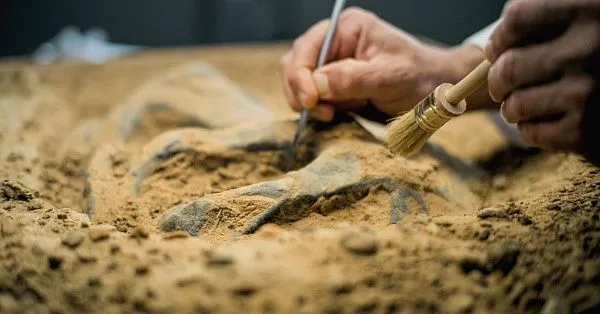
The North-West Archaeological Expedition of the State Hermitage Museum has successfully excavated piled Stone Age settlements in the valley of the Serteyka River in the Smolensk Region, where valuable bone and amber jewellery was found. This is reported by the Hermitage's official website.
Among the significant finds of the season are a pendant made from a boar's tusk and a breast ornament for men discovered in the cultural layer of the settlement of Serteya II, dating from 5-4 thousand years B.C.E. An anthropomorphic figure made of flint was also discovered, similar finds in this region have not been seen before.
Now scientists have to establish the purpose of the figurine: whether it was used as a pendant, amulet or had another purpose. There is also an opinion that the piece could have been unfinished, which would suggest local production of such artefacts.
According to Andrey Mazurkevich, head of the expedition, the new finds provide interesting data on trade relations of the local population and the cultural influence of steppe and forest-steppe cultures of Eastern Europe.
The researchers note that with the carriers of these cultures came the material culture: pottery, bone and horn products.
Photo: iStock-
 Society17.08.26Indonesia responds to aftermath of earthquake in East Nusa Tenggara Province
 -
![]()
 Society17.08.26Scientists rediscover rare plants thought extinct in Brazil for more than 30 years
 -
![]()


 Society17.08.26TV BRICS to present new television project on tackling land degradation at UN international conference in Mongolia
 -
![]()
 Society16.08.26BRICS News Digest for the previous week
 -
![]()
 Society16.08.26Chinese scientists uncover ancient reptile built for life in water
 -
![]()
 Society13.08.26Moscow to host India Day festival














-
![Sergey Lavrov]()
 Sergey LavrovRussian Foreign Minister"A Joint Statement of the Foreign Ministers has been adopted. It provides a clear and principled assessment of the situation on the international stage and outlines the tasks that will be addressed in accordance with previous decisions by heads of state and governments. No one doubts that additional documents on sectoral areas of cooperation will be developed ahead of the SCO summit in Bishkek. Energy, artificial intelligence, healthcare and a number of other areas were also mentioned"
 -
![Nitin Gadkari]() Nitin GadkariIndia's Union Minister for Road Transport and Highways"Our resolution has just been passed. It is very important as far as the BRICS countries are concerned, which cover 40 per cent of the world's population. We are committed to the futuristic development of the transport sector, to create cooperation, coordination and communication between the stakeholders. This resolution indicates a lot of new technology and innovation in the transport sector. It covers the road sector, railways, aviation and water transport"
Nitin GadkariIndia's Union Minister for Road Transport and Highways"Our resolution has just been passed. It is very important as far as the BRICS countries are concerned, which cover 40 per cent of the world's population. We are committed to the futuristic development of the transport sector, to create cooperation, coordination and communication between the stakeholders. This resolution indicates a lot of new technology and innovation in the transport sector. It covers the road sector, railways, aviation and water transport" -
![Anutin Charnvirakul]() Anutin CharnvirakulPrime Minister of Thailand"Russia has been a trusted friend of Thailand for over a century. […] Next year, we will mark the 130th anniversary of the establishment of diplomatic relations between our countries. We will commemorate this important milestone with high-level exchanges, thereby reaffirming our shared commitment to an even stronger partnership for the benefit of our peoples"
Anutin CharnvirakulPrime Minister of Thailand"Russia has been a trusted friend of Thailand for over a century. […] Next year, we will mark the 130th anniversary of the establishment of diplomatic relations between our countries. We will commemorate this important milestone with high-level exchanges, thereby reaffirming our shared commitment to an even stronger partnership for the benefit of our peoples"


