
















Chinese scientists uncover ancient reptile built for life in water
A 244-million-year-old fossil from China provides the earliest evidence of an archosauromorph highly adapted to life in water
-
![]()
Photo source: EvgeniyShkolenko / iStock
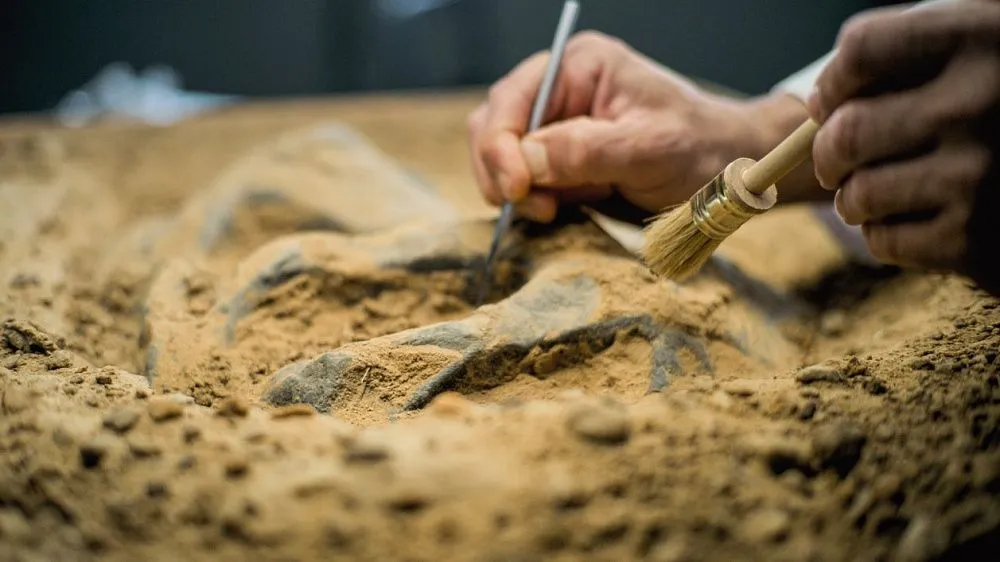
Chinese scientists have identified a new reptile species from Yunnan Province that lived about 244 million years ago and was highly adapted to an aquatic environment. Named Austronaga, the fossil provides the earliest known evidence of an almost fully aquatic archosauromorph – the evolutionary group that later gave rise to crocodiles, dinosaurs, pterosaurs and birds, reports China Daily, a partner of TV BRICS.
The study was led by Li Chun, a researcher at the Institute of Vertebrate Palaeontology and Paleoanthropology of the Chinese Academy of Sciences. The exceptionally well-preserved fossils were discovered in the Luoping biota and reveal several anatomical features associated with life in water.
Researchers found that Austronaga had significantly longer forelimbs than hindlimbs, while its reduced hindlimbs would have made movement on land difficult. Its enlarged hands and feet contained additional finger and toe bones, with the outermost bones lacking claws and forming flipper-like structures similar to those found in other aquatic reptiles.
A comparison with living and extinct aquatic animals showed that the proportions of Austronaga's limbs fell within the range of species that depend almost entirely on aquatic environments. Wang Wei, the first author of the study, said the findings indicate that the reptile had largely abandoned life on land and was well adapted to swimming.
The fossil also preserves traces of internal organs, including the stomach, liver and intestines. Researchers identified partially digested fish scales in the large intestine, providing evidence that Austronaga fed on fish. Its specialised limbs and diet suggest that it was an active aquatic predator.
The discovery expands scientific understanding of the early evolution of archosauromorphs and pushes evidence of their adaptation to aquatic environments back to around 244 million years ago. It also adds to knowledge of Tanysauria, the reptile group to which Austronaga belongs, which now includes known land-dwelling, semi-aquatic and highly aquatic representatives.
According to the researchers, the fossil offers a rare opportunity to examine the gradual adaptation of reptiles to aquatic environments following the end-Permian mass extinction. The findings could also help scientists investigate how different reptile groups responded to environmental changes and developed similar adaptations for life in water.
-
![]()
 Society13.09.26BRICS News Digest for the previous week
 -
![]()

 Society12.09.26Xi Jinping: China and India should view their bilateral relations from perspective of long-term development
 -
![]() Society12.09.26BRICS leaders adopt New Delhi Declaration at 18th Summit
Society12.09.26BRICS leaders adopt New Delhi Declaration at 18th Summit -
![]() Society12.09.26Narendra Modi proposes reforming global governance architecture and creating BRICS continuity mechanism
Society12.09.26Narendra Modi proposes reforming global governance architecture and creating BRICS continuity mechanism -
![]() Society12.09.2618th BRICS Summit begins in India
Society12.09.2618th BRICS Summit begins in India -
![]() Society11.09.26Russian Deputy Foreign Minister: BRICS Summit in India to consolidate group's role as flagship of multilateralism
Society11.09.26Russian Deputy Foreign Minister: BRICS Summit in India to consolidate group's role as flagship of multilateralism







-
![Ashok Mondal]()
 Ashok MondalNID Director"Signing this Memorandum of Understanding between the National Institute of Design (NID) and TV BRICS marks a pivotal milestone in advancing design diplomacy across the BRICS media space. This moment is especially significant as India hosts the 18th BRICS Summit, following India’s assumption of the BRICS chairship under the visionary leadership of Prime Minister Shri Narendra Modi. The partnership directly embodies his call to elevate Indian design standards through 'Design in India, Design for the World'. Through the global reach and broadcast capabilities of TV BRICS, we are excited to showcase the extraordinary visual storytelling, films, and design research of NID’s Film and Video Communication students to an international audience, while also welcoming and screening film works from BRICS network countries at NID Ahmedabad. This reciprocal exchange strengthens our shared commitment to educational, cultural, and artistic collaboration, fostering sustainable connections among global creative communities. NID Ahmedabad looks forward to leveraging this partnership to deepen cross-cultural dialogue, build international expert networks, and unlock transformative opportunities for filmmakers, researchers, and faculty across member nations"
 -
![Vladimir Putin]() Vladimir PutinPresident of Russia"We are developing mutual trade, which is growing; it increased by over 12 per cent last year. We have a joint commission working in this sphere. Our focus is on agriculture, shipbuilding, information technology and energy, including nuclear power. We have signed a free trade agreement between the Eurasian Economic Union and Indonesia. Jakarta is our reliable and old friend within ASEAN. We are working together at all international platforms, including the UN"
Vladimir PutinPresident of Russia"We are developing mutual trade, which is growing; it increased by over 12 per cent last year. We have a joint commission working in this sphere. Our focus is on agriculture, shipbuilding, information technology and energy, including nuclear power. We have signed a free trade agreement between the Eurasian Economic Union and Indonesia. Jakarta is our reliable and old friend within ASEAN. We are working together at all international platforms, including the UN" -
![Vladimir Putin]() Vladimir PutinPresident of Russia"More and more Iranian students are choosing Russian education. We are very pleased about this. A great many future doctors are studying in Russia. In the 2025–2026 academic year, the number of Iranian students in Russia approached 10,000, with 802 of them studying at the expense of the Russian state budget"
Vladimir PutinPresident of Russia"More and more Iranian students are choosing Russian education. We are very pleased about this. A great many future doctors are studying in Russia. In the 2025–2026 academic year, the number of Iranian students in Russia approached 10,000, with 802 of them studying at the expense of the Russian state budget" -
![Xi Jinping]() Xi JinpingPresident of the People’s Republic of China"The foundation of our bilateral relations will only grow stronger, and we will confidently move forward to a better future. […] The striving of nations on our planet for peace, development, cooperation and mutual benefit remains unchanged. The vital mission of the Shanghai Cooperation Organisation is to maintain stability and promote the development of our region"
Xi JinpingPresident of the People’s Republic of China"The foundation of our bilateral relations will only grow stronger, and we will confidently move forward to a better future. […] The striving of nations on our planet for peace, development, cooperation and mutual benefit remains unchanged. The vital mission of the Shanghai Cooperation Organisation is to maintain stability and promote the development of our region" -
![Alisher Salomov]() Alisher SalomovAdviser to the Chairman of the National Committee for Ecology and Climate Change of the Republic of Uzbekistan"First and foremost, I would like to highlight the importance of this Central Asia–Russia initiative, because environmental problems know no borders, and only a shared understanding of these problems and the search for joint solutions can deliver positive results"
Alisher SalomovAdviser to the Chairman of the National Committee for Ecology and Climate Change of the Republic of Uzbekistan"First and foremost, I would like to highlight the importance of this Central Asia–Russia initiative, because environmental problems know no borders, and only a shared understanding of these problems and the search for joint solutions can deliver positive results"