















Government plans legal reforms to transform large-scale farming clusters into professionally managed farmer-owned enterprises, boosting commercial agriculture and rural incomes
-
![]()
Photo source: fotoember / iStock
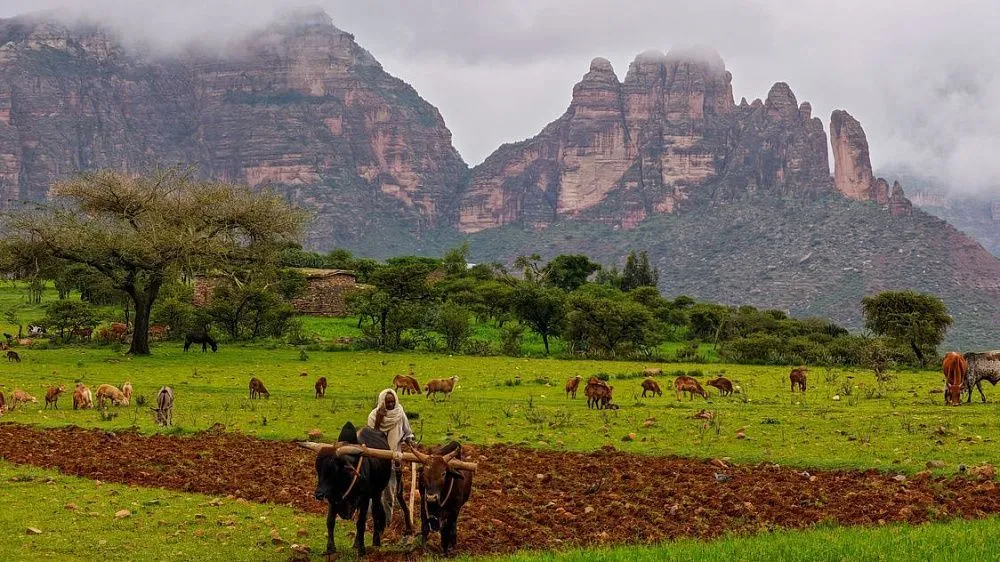
Ethiopia has launched a major agricultural reform programme aimed at converting farmer production clusters into legally recognised, farmer-owned agribusiness companies as part of efforts to modernise the rural economy and strengthen food security, as reported by Ethiopian Broadcasting Corporation, a TV BRICS partner.
The initiative will introduce new legal and management frameworks designed to help smallholder farmers move from informal collective production systems into structured agricultural enterprises while preserving individual land ownership rights.
Agriculture authorities said the transformation will focus on improving corporate governance, expanding access to finance, strengthening market connections and enabling farmers to operate as organised business entities capable of competing in larger agricultural markets.
The reform builds on Ethiopia’s cluster farming model, known locally as Kuta Getem, which allows farmers with neighbouring plots to voluntarily coordinate cultivation activities while maintaining ownership of their individual land. The approach has enabled rural producers to share access to agricultural technologies, improved seeds, fertilisers, mechanisation and modern farming practices.
The cluster farming system has expanded significantly over the past decade. The cultivated area under the model increased from around 600,000 hectares in 2011 to approximately 13 million hectares, involving more than 9.5 million smallholder farmers across the country.
Officials said the expansion of organised farming has contributed to a 29 per cent increase in overall crop productivity, demonstrating the potential of coordinated agricultural production to improve yields and strengthen rural livelihoods.
The next phase of the programme will focus on developing legal regulations, management training and financial skills programmes to help farmer-led enterprises operate effectively. Agricultural support institutions will also assist producers in building administrative capacity and adopting professional business practices.
Authorities believe that transforming farm clusters into farmer-owned agribusiness companies will create stronger links between producers and markets, improve household incomes and support Ethiopia’s long-term agricultural independence.
-
![]()
 Economy25.08.26Brazil’s airports handle record 11.9 million passengers in July
 -
![]()

 Economy25.08.26Expert: Africa needs to establish foothold in BRICS financial architecture
 -
![]()

 Economy25.08.26Indonesia and China to boost cooperation in artificial intelligence and microchip manufacturing
 -
![]()
 Economy25.08.26Ethiopia intends to turn Addis Ababa into African healthcare hub
 -
![]()
 Economy24.08.26Iran’s greenhouse exports climb 12% in latest agricultural year
 -
![]() Economy24.08.26China-Ethiopia trade deals exceed US$330 million as access to Chinese market expands
Economy24.08.26China-Ethiopia trade deals exceed US$330 million as access to Chinese market expands























-
![Joao Paulo Capobianco]()
 Joao Paulo CapobiancoBrazilian Minister of the Environment and Climate Change"The BRICS countries have a very high level of responsibility because they share an important part of the world's biodiversity, landscapes, populations, food production and water resources. So, we have an opportunity to lead by example. We have our development bank, which can demonstrate and develop new ways of financing programmes. We can reduce the risks for private capital to invest in restoration and efforts to combat desertification"
 -
![Dilma Rousseff]() Dilma RousseffPresident of the New Development Bank"India’s BRICS Presidency this year gives special significance to our discussion. NDB stands ready to be a trusted partner in turning commitments on sustainability, clean energy, smart and resilient infrastructure into concrete results on the ground. […] For NDB, mobilising private capital is a strategic imperative. Created by the BRICS founding members, NDB is a bank of the Global South, for the Global South, mandated to mobilise resources for infrastructure and sustainable development"
Dilma RousseffPresident of the New Development Bank"India’s BRICS Presidency this year gives special significance to our discussion. NDB stands ready to be a trusted partner in turning commitments on sustainability, clean energy, smart and resilient infrastructure into concrete results on the ground. […] For NDB, mobilising private capital is a strategic imperative. Created by the BRICS founding members, NDB is a bank of the Global South, for the Global South, mandated to mobilise resources for infrastructure and sustainable development" -
![Sihasak Phuangketkeow]() Sihasak PhuangketkeowDeputy Prime Minister and Minister of Foreign Affairs of Thailand"BRICS can play a very important role in maintaining the free flow of trade and investment. The group can also be a vehicle for all of us to engage and to look at economic opportunities"
Sihasak PhuangketkeowDeputy Prime Minister and Minister of Foreign Affairs of Thailand"BRICS can play a very important role in maintaining the free flow of trade and investment. The group can also be a vehicle for all of us to engage and to look at economic opportunities"