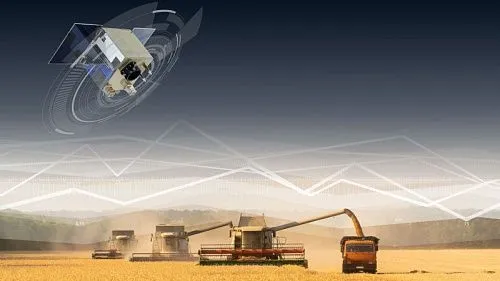

















The breakthrough could pave the way for biological computing circuits capable of detecting drought, pests and other environmental conditions directly through plant tissues
-
![]()
Photo source: Khanchit Khirisutchalual / iStock

Iranian researchers working with scientists from the Massachusetts Institute of Technology (MIT) have developed modified bacterial cells capable of functioning as biological transistors, opening a potential pathway towards computing systems that could allow plants to detect and respond to environmental changes. This is reported by NourNews, a TV BRICS partner.
The research, led by Iranian scientist Hamid Doosthosseini, focuses on creating fundamental components of computer architecture within living cells. Rather than building an entire biological circuit inside a single cell, the researchers engineered individual bacterial cells to perform the role of transistors.
The approach could eventually enable researchers to connect these biological transistors in different configurations and build more complex computing circuits capable of processing biological signals.
Each engineered cell can detect the presence of a specific target molecule and, depending on the result, transmit a signal to another component of the circuit. By combining multiple cells, scientists could potentially create systems capable of recognising several biological or environmental signals and producing a corresponding response.
“This allowed us to develop some of the fundamental components of computer architecture that are widely used," the scientist said.
The work represents a different approach to synthetic biology, where researchers typically engineer cells to produce particular proteins or transcription factors that interact with one another to perform specific functions, such as recognising a target molecule and generating an output.
By treating individual cells as modular computing components, the researchers aim to make biological circuits more flexible and scalable.
One potential future application is the development of circuits that could be placed on plant leaves or roots. Such systems could process signals generated by the plant's environment and identify conditions such as drought or pest attacks.
If developed further, plant-based biological computing could allow plants to act not only as biological organisms responding to their surroundings, but also as platforms for environmental sensing and information processing.
The technology remains at the research stage, and further work will be required before such circuits can be integrated into living plants and reliably used outside laboratory environments. Nevertheless, the development of bacterial cells capable of performing transistor-like functions marks a step towards combining synthetic biology with computing and could contribute to new approaches to agricultural monitoring and plant health.
-
![]()
 Technology27.08.26Russian students create smart AI voice recorder with on-device data processing
 -
![]()
 Technology26.08.26AI talent demand rises in China as graduate recruitment expands
 -
![]() Technology26.08.26China increases number of electric vehicle charging stations across country
Technology26.08.26China increases number of electric vehicle charging stations across country -
![]()
 Technology25.08.26Dubai reduces oil and fat testing time from two hours to two minutes
 -
![]()
 Technology25.08.26Iran develops device for more accurate monitoring of anaesthetic depth
 -
![]() Technology25.08.26China develops rice gene that combines earlier maturity with higher yields
Technology25.08.26China develops rice gene that combines earlier maturity with higher yields


























-
![Alisher Salomov]()
 Alisher SalomovAdviser to the Chairman of the National Committee for Ecology and Climate Change of the Republic of Uzbekistan"First and foremost, I would like to highlight the importance of this Central Asia–Russia initiative, because environmental problems know no borders, and only a shared understanding of these problems and the search for joint solutions can deliver positive results"
 -
![Joao Paulo Capobianco]() Joao Paulo CapobiancoBrazilian Minister of the Environment and Climate Change"The BRICS countries have a very high level of responsibility because they share an important part of the world's biodiversity, landscapes, populations, food production and water resources. So, we have an opportunity to lead by example. We have our development bank, which can demonstrate and develop new ways of financing programmes. We can reduce the risks for private capital to invest in restoration and efforts to combat desertification"
Joao Paulo CapobiancoBrazilian Minister of the Environment and Climate Change"The BRICS countries have a very high level of responsibility because they share an important part of the world's biodiversity, landscapes, populations, food production and water resources. So, we have an opportunity to lead by example. We have our development bank, which can demonstrate and develop new ways of financing programmes. We can reduce the risks for private capital to invest in restoration and efforts to combat desertification" -
![Dilma Rousseff]() Dilma RousseffPresident of the New Development Bank"India’s BRICS Presidency this year gives special significance to our discussion. NDB stands ready to be a trusted partner in turning commitments on sustainability, clean energy, smart and resilient infrastructure into concrete results on the ground. […] For NDB, mobilising private capital is a strategic imperative. Created by the BRICS founding members, NDB is a bank of the Global South, for the Global South, mandated to mobilise resources for infrastructure and sustainable development"
Dilma RousseffPresident of the New Development Bank"India’s BRICS Presidency this year gives special significance to our discussion. NDB stands ready to be a trusted partner in turning commitments on sustainability, clean energy, smart and resilient infrastructure into concrete results on the ground. […] For NDB, mobilising private capital is a strategic imperative. Created by the BRICS founding members, NDB is a bank of the Global South, for the Global South, mandated to mobilise resources for infrastructure and sustainable development" -
![Sihasak Phuangketkeow]() Sihasak PhuangketkeowDeputy Prime Minister and Minister of Foreign Affairs of Thailand"BRICS can play a very important role in maintaining the free flow of trade and investment. The group can also be a vehicle for all of us to engage and to look at economic opportunities"
Sihasak PhuangketkeowDeputy Prime Minister and Minister of Foreign Affairs of Thailand"BRICS can play a very important role in maintaining the free flow of trade and investment. The group can also be a vehicle for all of us to engage and to look at economic opportunities"