
















Funding will support basic healthcare and surgeries, with priority given to locally manufactured medical technologies

The Brazilian Government has announced an investment of around US$480 million for the purchase of more than 10,000 pieces of medical equipment to be used in basic care and surgical procedures. This is reported by Agencia Brasil.
In primary health care, the list includes items such as a refrigerator for storing vaccines, a digital fundus camera, electrocoagulation (electric scalpel), an automatic external defibrillator, a vascular Doppler, a low-power therapeutic laser, ultrasound for physiotherapy, and portable digital scales.
The list of specialised care includes items such as anaesthesiology equipment, a radiolucent electric surgical table, a portable ultrasound machine, an ophthalmic surgical microscope, an ophthalmic laser and a rigid video endoscopy system.
The procurement process will favour domestically manufactured products. Currently, Brazil supplies roughly 45 per cent of its own demand for medicines, vaccines, medical devices, materials, and health-related technologies. According to the government, the aim is to increase that figure to 50 per cent by 2026 and to 70 per cent by 2033.
Photo: iStock / PhonlamaiPhoto-
![]()
 Society28.08.26Vietnam develops silver economy focused on older people
 -
![]()

 Society28.08.26BRICS countries adopt Chennai Declaration
 -
![]()
 Society28.08.26Brazilian film industry aims to attract audiences in BRICS countries
 -
![]()


 Society27.08.26Role of media in promoting sustainable development goals was discussed at COP17 in Mongolia
 -
![]()
 Society27.08.26BRICS Summer School South Africa to bring together young leaders from BRICS and Global South
 -
![]()
 Society26.08.26Ethiopia reports major progress in healthcare coverage, local production and emergency preparedness



















-
![Alisher Salomov]()
 Alisher SalomovAdviser to the Chairman of the National Committee for Ecology and Climate Change of the Republic of Uzbekistan"First and foremost, I would like to highlight the importance of this Central Asia–Russia initiative, because environmental problems know no borders, and only a shared understanding of these problems and the search for joint solutions can deliver positive results"
 -
![Joao Paulo Capobianco]() Joao Paulo CapobiancoBrazilian Minister of the Environment and Climate Change"The BRICS countries have a very high level of responsibility because they share an important part of the world's biodiversity, landscapes, populations, food production and water resources. So, we have an opportunity to lead by example. We have our development bank, which can demonstrate and develop new ways of financing programmes. We can reduce the risks for private capital to invest in restoration and efforts to combat desertification"
Joao Paulo CapobiancoBrazilian Minister of the Environment and Climate Change"The BRICS countries have a very high level of responsibility because they share an important part of the world's biodiversity, landscapes, populations, food production and water resources. So, we have an opportunity to lead by example. We have our development bank, which can demonstrate and develop new ways of financing programmes. We can reduce the risks for private capital to invest in restoration and efforts to combat desertification" -
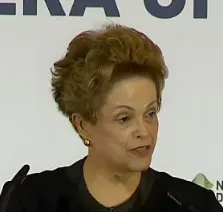
![Dilma Rousseff]() Dilma RousseffPresident of the New Development Bank"India’s BRICS Presidency this year gives special significance to our discussion. NDB stands ready to be a trusted partner in turning commitments on sustainability, clean energy, smart and resilient infrastructure into concrete results on the ground. […] For NDB, mobilising private capital is a strategic imperative. Created by the BRICS founding members, NDB is a bank of the Global South, for the Global South, mandated to mobilise resources for infrastructure and sustainable development"
Dilma RousseffPresident of the New Development Bank"India’s BRICS Presidency this year gives special significance to our discussion. NDB stands ready to be a trusted partner in turning commitments on sustainability, clean energy, smart and resilient infrastructure into concrete results on the ground. […] For NDB, mobilising private capital is a strategic imperative. Created by the BRICS founding members, NDB is a bank of the Global South, for the Global South, mandated to mobilise resources for infrastructure and sustainable development" -
![Sihasak Phuangketkeow]() Sihasak PhuangketkeowDeputy Prime Minister and Minister of Foreign Affairs of Thailand"BRICS can play a very important role in maintaining the free flow of trade and investment. The group can also be a vehicle for all of us to engage and to look at economic opportunities"
Sihasak PhuangketkeowDeputy Prime Minister and Minister of Foreign Affairs of Thailand"BRICS can play a very important role in maintaining the free flow of trade and investment. The group can also be a vehicle for all of us to engage and to look at economic opportunities"