















One of most remarkable stories of modern economy: BRICS experts reflect on group’s 20th Anniversary
A panel discussion featuring representatives from Russia, India, China, Brazil and South Africa was held at the BRICS+ Media Centre in Moscow
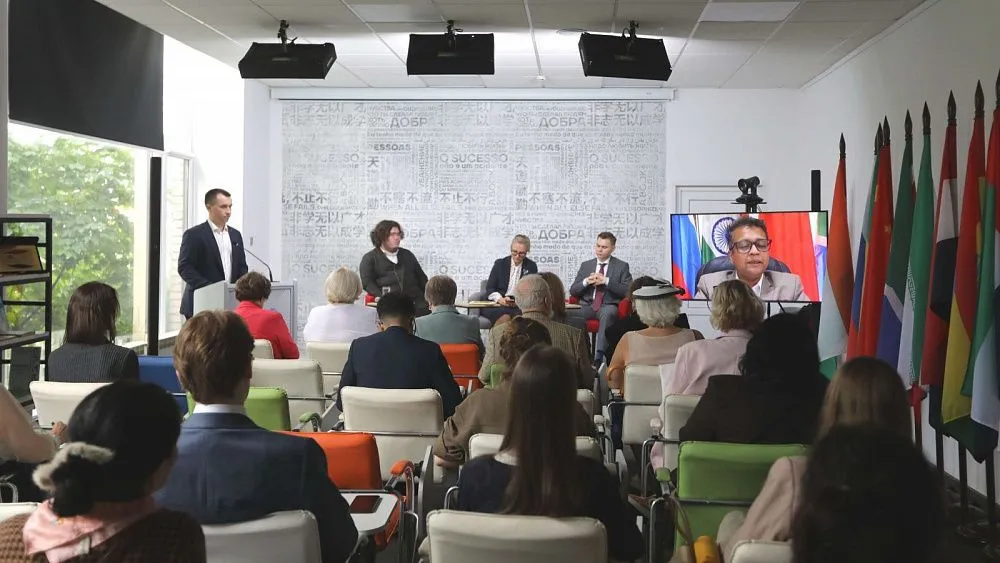


The panel session “BRICS – 20 Years: Results, Achievements and Prospects for Cooperation” took place at the BRICS+ Information and Cultural Media Centre, based at the M. I. Rudomino All-Russia State Library for Foreign Literature in Moscow. The event was held as part of BRICS Anniversary Week, organised by the TV BRICS International Media Network and the Library for Foreign Literature.
The discussion brought together representatives of international organisations, the expert community, scientific and cultural institutions, business circles and public organisations from BRICS countries. Experts from India, China, Brazil, South Africa, and Russia addressed participants via video messages.
Sameep Shastri, Chairman of the BRICS Chamber of Commerce and Industry (BRICS CCI) from India, described the group’s development as one of the most remarkable stories of the modern economy.


The head of BRICS CCI stressed that enterprises, including small and medium-sized businesses, are ready to establish direct cooperation. The challenge now, he said, is to create mechanisms that respond to this demand by strengthening business contacts and facilitating trade and cross-border connections, enabling companies across BRICS countries to find one another and grow together.
Wang Weipeng, a resident of the BRICS Incubation Park from China, said he had participated in China–Russia cross-border industrial, educational and technological cooperation and had witnessed the enormous potential of collaboration within BRICS. According to him, amid an increasingly unstable global landscape, BRICS has consistently adhered to the principle of multilateralism while promoting cooperation in trade, technological innovation and cultural education.

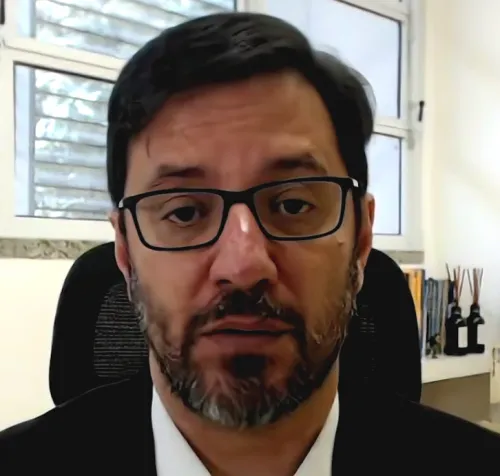
Fabio Borges, Coordinator of the BRICS Observatory Project in Brazil, noted that the most visible tangible outcome of BRICS cooperation has been the New Development Bank, whose establishment was agreed upon at the Fortaleza Summit in 2014. According to him, the institution differs from traditional organisations in that it operates on a horizontal basis, does not impose lending conditions, listens to the needs of Global South countries and pays close attention to environmental issues. Alongside the bank, the Contingent Reserve Arrangement was created as a mechanism similar to the International Monetary Fund (IMF) to support countries seeking to expand trade in national currencies.

The Brazilian expert stated that BRICS has become an influential force within the international system and offers alternative pathways towards building a world order capable of bringing greater peace and investment into economic and social development. He noted that this corresponds to the essence of Brazil’s foreign policy, namely South–South cooperation aimed at increasing investment in infrastructure and environmental initiatives.
Russian experts also addressed the session. Marina Zakharenko, Director General of the Library for Foreign Literature, opened the discussion, highlighting the symbolic significance of holding the event within the walls of the “Inostranka”, which has served as a platform for international humanitarian dialogue for more than a century.

TV BRICS Executive Producer Kristina Muravyova emphasised that the library communities of BRICS countries play an important role both in preserving cultural heritage and in creating new cultural content. The professional conclusions and opinions expressed throughout BRICS Anniversary Week will form the basis of new analytical and news materials. These will be published by national media outlets across BRICS countries, enabling a comprehensive assessment of the group’s prospects and helping identify new opportunities to achieve the United Nations (UN) Sustainable Development Goals.
 Photo: TV BRICS
BRICS Anniversary Week will continue until 20 June. The programme includes a series of cultural, educational and diplomatic events held at the BRICS+ Media Centre, reviewing the achievements of the group over the past 20 years in both the humanitarian and economic spheres.
-
![]()
 Society18.09.26President Prabowo Subianto pushes green transformation for Indonesia’s capital
 -
![]()
 Society17.09.2691% of Egyptians help elderly relatives to use digital services
 -
![]()

 Society16.09.26Balthasar Staehelin, Personal Envoy of President to China and Head of Regional Delegation for East Asia of International Committee of Red Cross: “We see BRICS as a format centred around a constructive agenda of jointly addressing global challenges”
 -
![]()

 Society16.09.26President of Vietnam and King of Thailand hold talks in Hanoi
 -
![]() Society16.09.26Expert: Indonesia uses BRICS membership to strengthen influence of Global South
Society16.09.26Expert: Indonesia uses BRICS membership to strengthen influence of Global South -
![]() Society13.09.26BRICS News Digest for the previous week
Society13.09.26BRICS News Digest for the previous week















-
![Ashok Mondal]()
 Ashok MondalNID Director"Signing this Memorandum of Understanding between the National Institute of Design (NID) and TV BRICS marks a pivotal milestone in advancing design diplomacy across the BRICS media space. This moment is especially significant as India hosts the 18th BRICS Summit, following India’s assumption of the BRICS chairship under the visionary leadership of Prime Minister Shri Narendra Modi. The partnership directly embodies his call to elevate Indian design standards through 'Design in India, Design for the World'. Through the global reach and broadcast capabilities of TV BRICS, we are excited to showcase the extraordinary visual storytelling, films, and design research of NID’s Film and Video Communication students to an international audience, while also welcoming and screening film works from BRICS network countries at NID Ahmedabad. This reciprocal exchange strengthens our shared commitment to educational, cultural, and artistic collaboration, fostering sustainable connections among global creative communities. NID Ahmedabad looks forward to leveraging this partnership to deepen cross-cultural dialogue, build international expert networks, and unlock transformative opportunities for filmmakers, researchers, and faculty across member nations"
 -
![Vladimir Putin]() Vladimir PutinPresident of Russia"We are developing mutual trade, which is growing; it increased by over 12 per cent last year. We have a joint commission working in this sphere. Our focus is on agriculture, shipbuilding, information technology and energy, including nuclear power. We have signed a free trade agreement between the Eurasian Economic Union and Indonesia. Jakarta is our reliable and old friend within ASEAN. We are working together at all international platforms, including the UN"
Vladimir PutinPresident of Russia"We are developing mutual trade, which is growing; it increased by over 12 per cent last year. We have a joint commission working in this sphere. Our focus is on agriculture, shipbuilding, information technology and energy, including nuclear power. We have signed a free trade agreement between the Eurasian Economic Union and Indonesia. Jakarta is our reliable and old friend within ASEAN. We are working together at all international platforms, including the UN" -
![Joao Paulo Capobianco]() Joao Paulo CapobiancoBrazilian Minister of the Environment and Climate Change"The BRICS countries have a very high level of responsibility because they share an important part of the world's biodiversity, landscapes, populations, food production and water resources. So, we have an opportunity to lead by example. We have our development bank, which can demonstrate and develop new ways of financing programmes. We can reduce the risks for private capital to invest in restoration and efforts to combat desertification"
Joao Paulo CapobiancoBrazilian Minister of the Environment and Climate Change"The BRICS countries have a very high level of responsibility because they share an important part of the world's biodiversity, landscapes, populations, food production and water resources. So, we have an opportunity to lead by example. We have our development bank, which can demonstrate and develop new ways of financing programmes. We can reduce the risks for private capital to invest in restoration and efforts to combat desertification" -
![Dilma Rousseff]() Dilma RousseffPresident of the New Development Bank"India’s BRICS Presidency this year gives special significance to our discussion. NDB stands ready to be a trusted partner in turning commitments on sustainability, clean energy, smart and resilient infrastructure into concrete results on the ground. […] For NDB, mobilising private capital is a strategic imperative. Created by the BRICS founding members, NDB is a bank of the Global South, for the Global South, mandated to mobilise resources for infrastructure and sustainable development"
Dilma RousseffPresident of the New Development Bank"India’s BRICS Presidency this year gives special significance to our discussion. NDB stands ready to be a trusted partner in turning commitments on sustainability, clean energy, smart and resilient infrastructure into concrete results on the ground. […] For NDB, mobilising private capital is a strategic imperative. Created by the BRICS founding members, NDB is a bank of the Global South, for the Global South, mandated to mobilise resources for infrastructure and sustainable development" -
![Sihasak Phuangketkeow]() Sihasak PhuangketkeowDeputy Prime Minister and Minister of Foreign Affairs of Thailand"BRICS can play a very important role in maintaining the free flow of trade and investment. The group can also be a vehicle for all of us to engage and to look at economic opportunities"
Sihasak PhuangketkeowDeputy Prime Minister and Minister of Foreign Affairs of Thailand"BRICS can play a very important role in maintaining the free flow of trade and investment. The group can also be a vehicle for all of us to engage and to look at economic opportunities"