















Experts identify effective communication strategies for economic development at forum in Moscow
Modern communication technologies are a management tool
-
![]()
Photo source: phakphum patjangkata / iStock

The 2nd International Forum "Strategic Communications. Ideas & Insights" took place at the Digital Business Space in Moscow. The event highlighted the important role of communication technologies in business and public administration in strengthening the country’s sovereignty.
The forum brought together around 700 participants from more than 50 regions of Russia and other countries. Among the participants were 120 speakers from Russia, Argentina, Brazil, India, China, and Uzbekistan, as well as experts from BRICS and the Shanghai Cooperation Organisation (SCO). The TV BRICS International Media Network acted as the event’s international media partner.
"This year, almost twice as many delegates attended our event, which shows that we are on the right track. From the very beginning, we have focused on cooperation with state institutions, which allows us to raise the issues facing the communications sector to the highest possible level. We hope that our platform is gradually developing its own distinctive character, setting it apart from other events through the depth of its expertise, the ambition of its objectives, and its focus on the future development of the industry," said Andrey Lapshov, Chairman of the Association of Communications Consultancies (AKOS).
The forum’s programme included three plenary panels, which focused on the prospects for the development of the communications industry and market (which was valued at US$32.6 billion by the end of 2025), the experience of creating and promoting Russian brands, illustrated by 10 real-life case studies, and how to build trust between countries through communications in the current climate.
The forum hosted seven thematic expert discussions on artificial intelligence (AI) and neuro-PR, the media, creative products in the communications industries, the new role of internal communications, communications research, the personal brand of business leaders, and crisis communication technologies.
Several experimental formats also took place, including the international teleconference "Codes and Constructors of National Brands", during which experts discussed what makes countries understandable and trustworthy to external partners. Speaking at the teleconference, Tatyana Kocherova, Head of International Projects at TV BRICS, noted that when communicating with an audience, it is important to speak their language – to adapt to the cultural and social context.
"Humanitarian projects represent a separate dimension, bringing history into the realm of living human interaction. TV BRICS pays particular attention to this area in its work. One key example is the BRICS+ Information and Cultural Media Centre, established at the M. I. Rudomino All-Russia State Library for Foreign Literature in Moscow. This is a space where professional and public dialogue takes place not in the format of official negotiations but through culture, knowledge and lively interaction – precisely what forges lasting ties between countries," she added.
Tatyana Kocherova emphasised that publishing content through partner media outlets provides access to an audience that often does not engage directly with foreign news sources. As a result, information about the projects, initiatives and achievements of the BRICS countries reaches the end user via communication channels with which they are familiar and which they regard as authoritative, significantly increasing the level of trust in the content and the effectiveness of its reception.
For the first time, the forum hosted a creative pitch session for communications agencies. Guests were able to mingle in the media and book lounges, whilst a youth programme and masterclasses were also organised. The forum also hosted an open industry meeting attended by the leadership of key Russian communications associations, as well as an all-Russian seminar for press officers and PR specialists responsible for providing media coverage of the creative industries across Russia’s regions.
"At the event, we addressed a number of systemic issues. Experts from more than 50 regions were able to exchange best practices and develop a unified approach to the communication and promotion of the creative economy," emphasised Tatyana Ilyushnikova, Deputy Minister of Economic Development of Russia.
The forum featured expert resources for the market, specially prepared by AKOS and its partners: an industry code of practice, research, guides and recommendations.
The first code of practice for good-faith interaction between clients and service providers in the public relations sector was approved by representatives of the AKOS Advisory Council (which brings together 30 heads of communications departments in large companies and federal government bodies) and industry associations in the communications sector. The document contains a list of best practices that responsible clients can use as guidelines when making decisions and resolving disputes.
The 2nd International Forum "Strategic Communications. Ideas & Insights" was organised by AKOS. For the second year running, it was held with the support of the Russian Ministry of Economic Development, the Russian Ministry of Foreign Affairs and the Expert Council for the Development of the Creative Economy under the Russian State Duma’s Committee on Economic Policy. The forum reflects and supports an international trend that is radically changing attitudes towards communications.
-
![]()
 Economy02.09.26Ethiopia earns more than US$4.55 billion from agricultural exports in 2025/26
 -
![]()


 Economy02.09.26Vietnam proposes five priorities for ASEAN-Russia economic cooperation
 -
![]() Economy02.09.26Russia introduces new tools to boost creative industries up to 6% by 2030
Economy02.09.26Russia introduces new tools to boost creative industries up to 6% by 2030 -
![]()
 Economy02.09.26UAE raises clean energy target to 35% by 2030–2031
 -
![]()
 Economy01.09.26China’s Pinglu Canal set to reshape trade links with ASEAN
 -
![]() Economy01.09.26Ethiopia increases electricity exports by 25% and records record revenue for financial year
Economy01.09.26Ethiopia increases electricity exports by 25% and records record revenue for financial year
















-
![Xi Jinping]()
 Xi JinpingPresident of the People’s Republic of China"The foundation of our bilateral relations will only grow stronger, and we will confidently move forward to a better future. […] The striving of nations on our planet for peace, development, cooperation and mutual benefit remains unchanged. The vital mission of the Shanghai Cooperation Organisation is to maintain stability and promote the development of our region"
 -
![Alisher Salomov]() Alisher SalomovAdviser to the Chairman of the National Committee for Ecology and Climate Change of the Republic of Uzbekistan"First and foremost, I would like to highlight the importance of this Central Asia–Russia initiative, because environmental problems know no borders, and only a shared understanding of these problems and the search for joint solutions can deliver positive results"
Alisher SalomovAdviser to the Chairman of the National Committee for Ecology and Climate Change of the Republic of Uzbekistan"First and foremost, I would like to highlight the importance of this Central Asia–Russia initiative, because environmental problems know no borders, and only a shared understanding of these problems and the search for joint solutions can deliver positive results" -
![Joao Paulo Capobianco]() Joao Paulo CapobiancoBrazilian Minister of the Environment and Climate Change"The BRICS countries have a very high level of responsibility because they share an important part of the world's biodiversity, landscapes, populations, food production and water resources. So, we have an opportunity to lead by example. We have our development bank, which can demonstrate and develop new ways of financing programmes. We can reduce the risks for private capital to invest in restoration and efforts to combat desertification"
Joao Paulo CapobiancoBrazilian Minister of the Environment and Climate Change"The BRICS countries have a very high level of responsibility because they share an important part of the world's biodiversity, landscapes, populations, food production and water resources. So, we have an opportunity to lead by example. We have our development bank, which can demonstrate and develop new ways of financing programmes. We can reduce the risks for private capital to invest in restoration and efforts to combat desertification" -
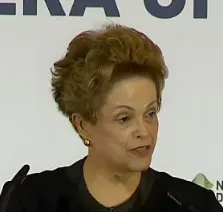
![Dilma Rousseff]() Dilma RousseffPresident of the New Development Bank"India’s BRICS Presidency this year gives special significance to our discussion. NDB stands ready to be a trusted partner in turning commitments on sustainability, clean energy, smart and resilient infrastructure into concrete results on the ground. […] For NDB, mobilising private capital is a strategic imperative. Created by the BRICS founding members, NDB is a bank of the Global South, for the Global South, mandated to mobilise resources for infrastructure and sustainable development"
Dilma RousseffPresident of the New Development Bank"India’s BRICS Presidency this year gives special significance to our discussion. NDB stands ready to be a trusted partner in turning commitments on sustainability, clean energy, smart and resilient infrastructure into concrete results on the ground. […] For NDB, mobilising private capital is a strategic imperative. Created by the BRICS founding members, NDB is a bank of the Global South, for the Global South, mandated to mobilise resources for infrastructure and sustainable development" -
![Sihasak Phuangketkeow]() Sihasak PhuangketkeowDeputy Prime Minister and Minister of Foreign Affairs of Thailand"BRICS can play a very important role in maintaining the free flow of trade and investment. The group can also be a vehicle for all of us to engage and to look at economic opportunities"
Sihasak PhuangketkeowDeputy Prime Minister and Minister of Foreign Affairs of Thailand"BRICS can play a very important role in maintaining the free flow of trade and investment. The group can also be a vehicle for all of us to engage and to look at economic opportunities"