














“Salt of the Earth” Festival in Russia features films from India, Brazil, Iran and Venezuela
Special screening held with the support of TV BRICS
-
![]()
Photo source: 19th International Film Festival “Salt of the Earth”
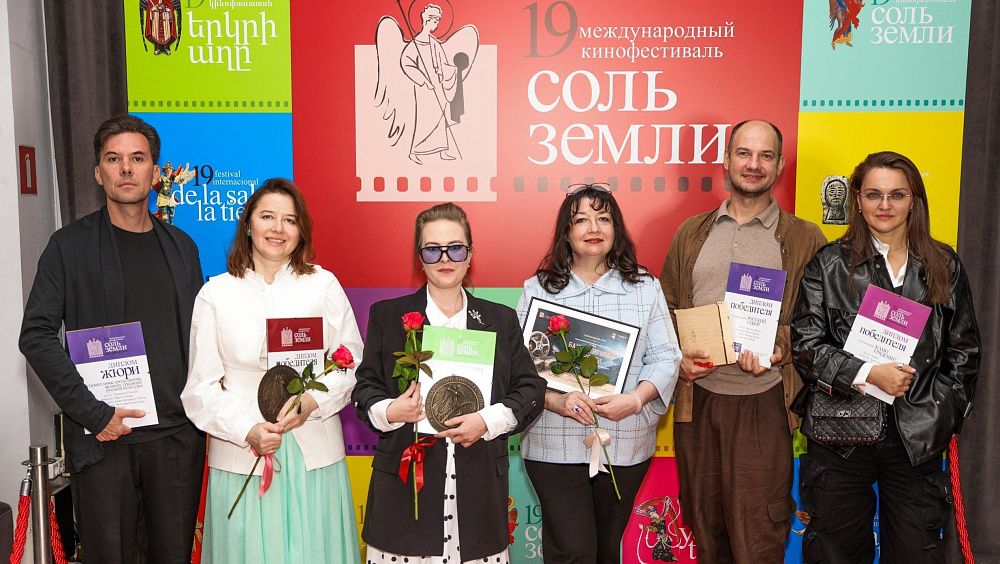
The results of the International Film Festival “Salt of the Earth” were announced in Samara. The winners received 18 awards. The Grand Prix was awarded to the film “Where Swallows Live” directed by Katrina Romanova (Arkhangelsk Region, Moscow, VGIK studio).
The Governor of the Samara Region’s Award went to the film “Return Address: Starshina” directed by Ulyana Gerasimova (Moscow). The Samara Mayor’s Award was presented to the local film “Grigory Aksakov. A Romantic in Public Service” directed by Inga Penner. Five more films became winners in their respective categories, while jury diplomas and the Audience Choice Award were also presented.
“Around 500 applications were submitted. Our film festival has long gone beyond the borders of the Samara Region and has become one of the most significant events in the world of documentary cinema. In the year of Samara’s 440th anniversary, this is one of the key cultural events. I congratulate all the winners and look forward to seeing everyone at the anniversary festival next year!” said Samara Mayor Ivan Noskov.
TV BRICS became the festival’s international organisational partner. The internatuonal media network held a special screening of films from its partners in India, Brazil, Iran, China and Venezuela. Viewers watched “Whisper of Wild Nature” (India, Innovative Film Academy), “My Sister, Clara” (Brazil, directed by Diego Alexandre), “Charming Beijing!” (a joint production by TV BRICS, China Daily and the Press Centre of the People’s Government of Beijing), as well as an episode of the programme"Day of the Dead: Culture and Loyalty to Tradition" (Venezuela, teleSUR).
Ivan Zakharenko, Head of the Thematic Broadcasting and Special Media Projects Department at TV BRICS and a film director, served on the festival jury. He presented the international media network’s new documentary film “Earth. Lifelines”. The project addresses the global issue of land degradation and demonstrates solutions through the example of Russia. The film was created in support of the “Silk Road Caravan” initiative implemented in 2026 by the United Nations Convention to Combat Desertification.
The TV BRICS Special Award, which gives the recipient the right to have their film broadcast on the international media network, was awarded to "Bayun of the Zhiguli and Volga” directed by Viktoria Garmashova. Zakharenko noted that the film about the friendship between Sergey Esenin and Volga poet Aleksander Shiryaevets allows an international audience to see the “human dimension” of Russian culture through the stories of lesser-known figures.
“The film is filled with stunning Volga landscapes. For TV BRICS, this is an opportunity to show Russia not through major metropolitan cities, but through lesser-known perspectives. In this respect, we are especially aligned with the festival,” he emphasised.
According to the director, the competition programme also clearly demonstrated a trend towards reflecting contemporary life through regional identity.
“These films are about disappearing traditional cultures of small peoples, preserving the heritage of the past and adapting it to modern realities. At the same time, the authors of such topics are often very young directors, recent graduates. A vivid example is ‘Where Swallows Live’, the winner of the Grand Prix,” he said.
The festival’s competition programme included 30 films, while another 35 were screened out of competition.
-
![]()
 Culture21.09.26Bolivian film wins four awards at Lions of Fire Film Festival
 -
![]()
 Culture16.09.26ArtMasters Open International Competition announces winners in "Film" and "Music"
 -
![]()
 Culture11.09.26Republic of India to promote creative industries abroad through TV BRICS
 -
![]()
 Culture09.09.26"Russian theatre changes world's perception of performing arts" – InteRussia participants on their fellowship at GITIS
 -
![]()
 Culture03.09.26FAM 2026 International Film Festival returns to Santa Catarina, celebrating 30 years
 -
![]()
 Culture26.08.26Films from BRICS countries to be screened at “Salt of the Earth” Film Festival in Russia










-
![Ashok Mondal]()
 Ashok MondalNID Director"Signing this Memorandum of Understanding between the National Institute of Design (NID) and TV BRICS marks a pivotal milestone in advancing design diplomacy across the BRICS media space. This moment is especially significant as India hosts the 18th BRICS Summit, following India’s assumption of the BRICS chairship under the visionary leadership of Prime Minister Shri Narendra Modi. The partnership directly embodies his call to elevate Indian design standards through 'Design in India, Design for the World'. Through the global reach and broadcast capabilities of TV BRICS, we are excited to showcase the extraordinary visual storytelling, films, and design research of NID’s Film and Video Communication students to an international audience, while also welcoming and screening film works from BRICS network countries at NID Ahmedabad. This reciprocal exchange strengthens our shared commitment to educational, cultural, and artistic collaboration, fostering sustainable connections among global creative communities. NID Ahmedabad looks forward to leveraging this partnership to deepen cross-cultural dialogue, build international expert networks, and unlock transformative opportunities for filmmakers, researchers, and faculty across member nations"
 -
![Vladimir Putin]() Vladimir PutinPresident of Russia"We are developing mutual trade, which is growing; it increased by over 12 per cent last year. We have a joint commission working in this sphere. Our focus is on agriculture, shipbuilding, information technology and energy, including nuclear power. We have signed a free trade agreement between the Eurasian Economic Union and Indonesia. Jakarta is our reliable and old friend within ASEAN. We are working together at all international platforms, including the UN"
Vladimir PutinPresident of Russia"We are developing mutual trade, which is growing; it increased by over 12 per cent last year. We have a joint commission working in this sphere. Our focus is on agriculture, shipbuilding, information technology and energy, including nuclear power. We have signed a free trade agreement between the Eurasian Economic Union and Indonesia. Jakarta is our reliable and old friend within ASEAN. We are working together at all international platforms, including the UN" -
![Joao Paulo Capobianco]() Joao Paulo CapobiancoBrazilian Minister of the Environment and Climate Change"The BRICS countries have a very high level of responsibility because they share an important part of the world's biodiversity, landscapes, populations, food production and water resources. So, we have an opportunity to lead by example. We have our development bank, which can demonstrate and develop new ways of financing programmes. We can reduce the risks for private capital to invest in restoration and efforts to combat desertification"
Joao Paulo CapobiancoBrazilian Minister of the Environment and Climate Change"The BRICS countries have a very high level of responsibility because they share an important part of the world's biodiversity, landscapes, populations, food production and water resources. So, we have an opportunity to lead by example. We have our development bank, which can demonstrate and develop new ways of financing programmes. We can reduce the risks for private capital to invest in restoration and efforts to combat desertification" -
![Dilma Rousseff]() Dilma RousseffPresident of the New Development Bank"India’s BRICS Presidency this year gives special significance to our discussion. NDB stands ready to be a trusted partner in turning commitments on sustainability, clean energy, smart and resilient infrastructure into concrete results on the ground. […] For NDB, mobilising private capital is a strategic imperative. Created by the BRICS founding members, NDB is a bank of the Global South, for the Global South, mandated to mobilise resources for infrastructure and sustainable development"
Dilma RousseffPresident of the New Development Bank"India’s BRICS Presidency this year gives special significance to our discussion. NDB stands ready to be a trusted partner in turning commitments on sustainability, clean energy, smart and resilient infrastructure into concrete results on the ground. […] For NDB, mobilising private capital is a strategic imperative. Created by the BRICS founding members, NDB is a bank of the Global South, for the Global South, mandated to mobilise resources for infrastructure and sustainable development" -
![Sihasak Phuangketkeow]() Sihasak PhuangketkeowDeputy Prime Minister and Minister of Foreign Affairs of Thailand"BRICS can play a very important role in maintaining the free flow of trade and investment. The group can also be a vehicle for all of us to engage and to look at economic opportunities"
Sihasak PhuangketkeowDeputy Prime Minister and Minister of Foreign Affairs of Thailand"BRICS can play a very important role in maintaining the free flow of trade and investment. The group can also be a vehicle for all of us to engage and to look at economic opportunities"